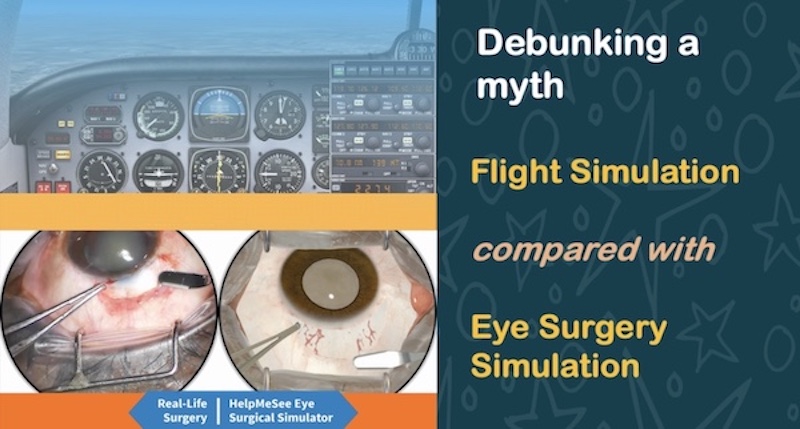
When talking about simulation for training, flight simulation is the prime reference for realism and training outcomes. Various other domains or industries therefore discuss and compare simulation fidelity and the quality of simulation based training with flight simulation and training. This includes those involved with surgical simulation.
Quite often while discussing surgical simulation for cataract surgery, I hear this view from some ophthalmologists, that “Every eye is different and every case is unique. That makes cataract surgery challenging in comparison with flight simulation wherein the aircraft remains the same”.
Notice that the comparison is being made between the aircraft and the eye. The aircraft is an engineering marvel that operates consistently with high precision. On the other hand, the patient eyes and surgical conditions have innumerable variations. While it appears to be a reasonable argument, it is a misconception.
Simulation is essentially an “experience” wherein the participant interacts or operates in the simulated environment to learn something valuable out of that experience.
“Simulation for training” is not just simulating the function of a particular device or object. It is simulation of the cause and effect of specific actions in the simulated environment. The interactions between various sub-systems or components of the environment are simulated.
Both simulated environments have variability in conditions that add complications and complexity. In flight simulation, the variability in simulation scenario comes from large number of factors e.g. weather conditions (temperature, wind), aircraft load. Weather conditions change continuously as aircraft flies across the route. In cataract surgery, there are pre-existing conditions as well as results of surgical actions that lead to constant evolution of the scenario.
It is critical to understand that the aircraft is not equivalent to the eye in these simulation scenarios for training. The aircraft is equivalent to the surgical instruments in cataract surgery. The design, features and function of the surgical instruments can be specified and standardized for the purpose of simulation just as the operation of the aircraft is in flight simulation.
I would like to draw your attention to the fact that the term used to describe simulation for flight training is “Flight Simulation”. It is not “Aircraft Simulation”. In the same way, for training on any particular surgical procedure such as Manual Small Incision Cataract Surgery (MSICS) and Phacoemulsification Cataract Surgery, it has to be understood as “Surgical Simulation” (in this example, “Cataract Surgery Simulation”) and not “Eye Simulation”.
The table below represents the equivalence between the two types of simulation scenarios being discussed:


Both the simulation scenarios are complicated with several sub-systems and their interdependencies. Aircraft simulation technologies have evolved significantly and matured over decades while surgical simulation can be considered to be at an early stage.
At the same time, it is understood that the nature of interactions and the skills required for performance vary significantly between the two scenarios. The learning principles behind simulation based training would remain the same, however their application must vary in alignment with knowledge and skills associated with specific task performance requirements.
The success with simulation based flight training is exemplary however any comparison between flight training and surgical simulation for any surgical procedure not just cataract surgery, and adoption of principles and practices for effective training design and delivery is required to be made carefully and thoughtfully.
#surgicalsimualtion #cataractsurgery #flighttraining #flightsimulation #training #simulation #comparison #complexity #challenges