Simulators and Simulation – History
Simulators and simulation have been used for ages in many different domains. Many of us engage in activities involving simulation without consciously realizing it. For instance, we get immersed in the story while watching movies at a theater. We experience being present as an observer in the story and get passively involved. The degree of immersion and engagement is further enhanced with multidimensional movies such as 3D or 5D movies.

Comparison of training models

Simulators and simulations have been used in the medical domain for centuries. Cadavers, animal tissues and other artificial models have been used extensively for learning. The pace and the quantum of advancement in the medical domain, however, appear to be low in comparison with the aviation industry. It has grabbed attention in recent times quite significantly, though.
Compare that with its adoption and growth in aviation. Aircraft were invented in early 1900s. The use of simulation technology for training in aviation is quite popular and regarded to be the best and exemplary. Quantum leap has been made in the sophistication of devices, what they simulate and how they get used for training delivery – all in a relatively short period of time.
One may wonder what may have caused such advancements in flight simulation at a skyrocketing pace as well as the speed of its adoption, within just a few decades. It piqued my interest in comparing that with the growth of simulation in the healthcare industry, particularly in the area of surgical skills training.
It appears that there were two key factors responsible for these advancements and adoption. One was the quantifiable and tangible value from adoption of simulation for flight training. The other was the criticality of the quality of training outcomes for growth and survival of the industry itself. During World War II, more pilots were dying in training than on the battlefield. The demand for training pilots in large numbers and that too rapidly was quite high, while the risk and losses in the process were just not acceptable. There was a desperate need for improving the safety, efficiency and quality of training. That paved the way for the development of simulators and their adoption for flight training.
One must consider that the core activity of the aviation industry is flying. While flying was fascinating, it was risky. Its growth and survival depended on making it safe. Clearly, better training of pilots was crucial to achieving that goal. Clearly as Al Ueltschi, a pioneer in the use of flight simulation, and Founder of FlightSafety International, has emphatically stated.
“The most important safety device in an aircraft is a well-trained pilot.“
Al Ueltschi, Founder, FlightSafety International.
Here are a few other significant differences between the two domains:
- Surgery, though a significant activity in healthcare, is not the core or principal one. Doctors are educated and trained to do a lot more than operate, and indeed do a lot more than that. The principal training programs such as residency and fellowships are much wider in scope than simply covering surgical skills. While learning how to fly is at the centre-stage of any flight training program.
- There are a multitude of surgical procedures. Many of them are complex wherein simulation based training can very beneficial. However, the simulation requirements vary immensely when compared with the design of flight simulation.
- The education and training system in healthcare has become tightly integrated within its delivery model. The Continuous Medical Education (CME) and other informal courses are not mandatory and usually quite short with limited objectives.
The healthcare and surgical skills training has successfully employed the Halsted model of “See One, Do One and Teach One” for more than 100 years. The Apprenticeship model of training has been working to the satisfaction of the medical community and is widely accepted. Considering the entire curriculum, that system is indeed very effective. However, the situation is exactly the opposite in the aviation domain. The business of aviation is all about flying as its core activity. What is more, a serious need was felt for separating of training from the actual operational model. That was achieved with the use of simulation-based training.
Key focus on safety and achievement of training objectives
The transition did not take place overnight. Simulators did not immediately replace in-flight training as soon as the first simulator was produced. The need was so strong that the first generation of training devices, even with their very limited functions and low levels of realism, were accepted. See the image of one of the earliest flight simulators called the ‘Link Trainer’. The level of “Realism” did not come in the way. The limitations were known and understood.
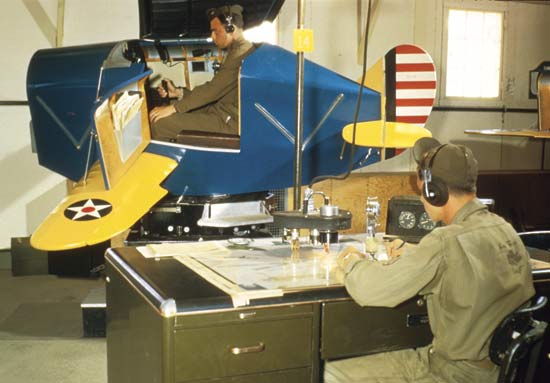
The devices were used for achievement of a definite and narrow set of training objectives for which they were designed. The driving principle was acquisition of knowledge and skills to the best possible level before one stepped into a real aircraft. This would help reduce the possibilities of losing both the pilot and the aircraft with any major performance error during a training flight.
Lower fidelity of devices, not just in terms of the limited training objectives supported but also low level of realism, never came in the way of their adoption. The perceived value was high and needed no statistical evidence. The real value was established in practice. Practice further helped identify and make improvements – both in the devices and in the process of training, with incorporation of the best learning principles in order to raise the quality of training outcomes.
Consequently, the aviation industry as also the training system developers made stupendous progress in a relatively short period of time. Today, it is possible to qualify a pilot simply on the performance demonstrated on the simulator. The surgical skills training remained entrenched in “Learning by doing” and the ‘Apprenticeship Model of Training’, because the model is indeed good for the broader set of objectives. It is an effective means of holistic training. It is challenging to separate surgical skills training from this tightly integrated model of training and delivery of care.
Times have changed; how is the system responding?
With time, the conditions of training have changed, and constraints have grown. The demands on the model changed to which it cannot respond as this calls for an increase in patient volumes. Add the ethical concerns to the mix. However, the practice and trust in live surgical training remains very strong for obvious reasons. After all, what can compete with “realism” itself. The fidelity of live surgical training cannot be challenged.
The impact of rising constraints that cannot be managed is possibly accepted as a systemic one. Acceptance of such impact on the training outcomes and the level of effectiveness is rationalized as achievement of what is best possible within the constraints of the current training model. In any case, in most of the world, residents are assessed for far more than surgeries in their discipline. Surgical competence is a part of the complete residency or fellowship program objectives. Assessment of its competence is seldom performance based. That appears to have weakened the demand for making substantive and transformative changes to training systems and methodologies. There is serious thought and concern, but solutions have been hard to find and implement.
Wait before making any conclusions though. There are some examples of success as well.

Some significant technological advancements in the process and tools of surgery have been made in the last 20 to 30 years. These primarily include techniques such as Minimally Invasive Surgery (MIS). The MIS procedures became very popular from early 1990s and robotic surgery in the recent times.

The issue of effective training in the use of these MIS devices and minimizing surgical errors gave impetus to the demand for development and use of simulators in training. The need for growth and success for this new and advanced technology kickstarted a new era in the use of simulation for surgical skills training. Device manufacturers and surgeons have worked together to make this possible. As a result, there are some successful programs today both with low-fidelity box-trainers and with high-fidelity virtual reality simulators. In fact, select countries have even made simulation-based training and certification mandatory before one can practice such surgical procedures.
Driving this change is the underlying end-customer demand for a safe procedure, better outcomes and faster recovery, all of which are supported and backed by the medical devices industry as well. The combined effect is positive.
There are also many progressive, forward-thinking institutions, and quite a few of them are making efforts to integrate simulation into surgical skills training. There is sufficient insight if not conclusive evidence that success depends on the quality of integration of simulation in training more than anything else.
Without compelling reasons for adoption and other market drivers, the best of the simulators will not deliver on their promise even if they can.
A conscious, collective effort by all the key stakeholders in healthcare delivery is necessary to accelerate the pace of this transition to safer and more effective mode of training.